There is something about the legal profession that never lets you stop being a student.
Titles may change. Roles may evolve.
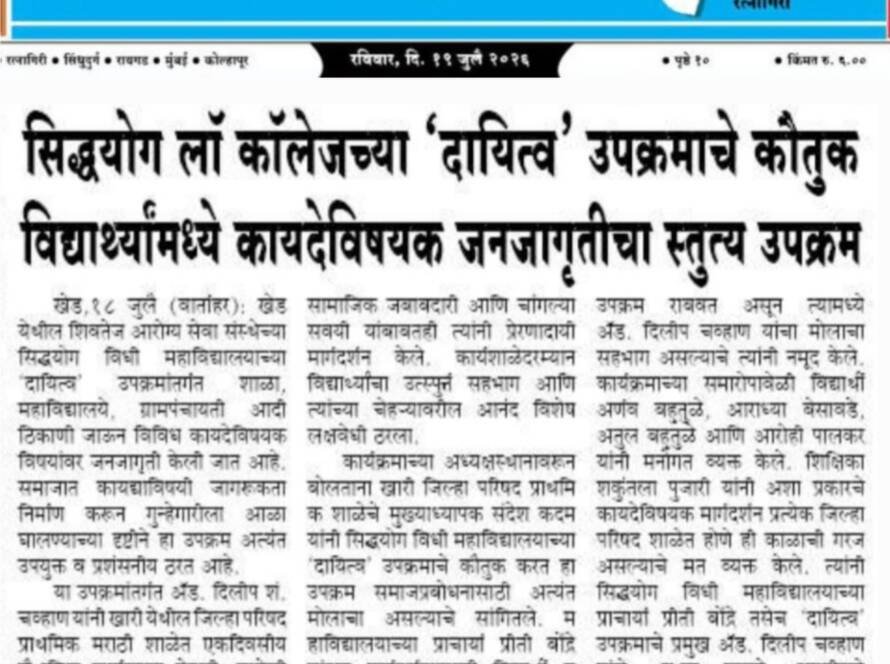
Today, I spend much of my time as the I/c Principal of a law college, balancing academic leadership with administrative responsibilities. Yet, beneath every administrative decision still lives the lawyer in me…curious, questioning, researching, and constantly learning.
For a lawyer, fulfilment is not measured by how busy the day was, but by how much it enriched the mind. Every meaningful discussion, every insightful lecture, and every opportunity to learn deepens one’s understanding of the law. The law is far too vast and dynamic for anyone to claim complete mastery. Perhaps that is the greatest beauty of this profession, because the learning never ends.
After quite some time, I experienced one such day of intense learning again.
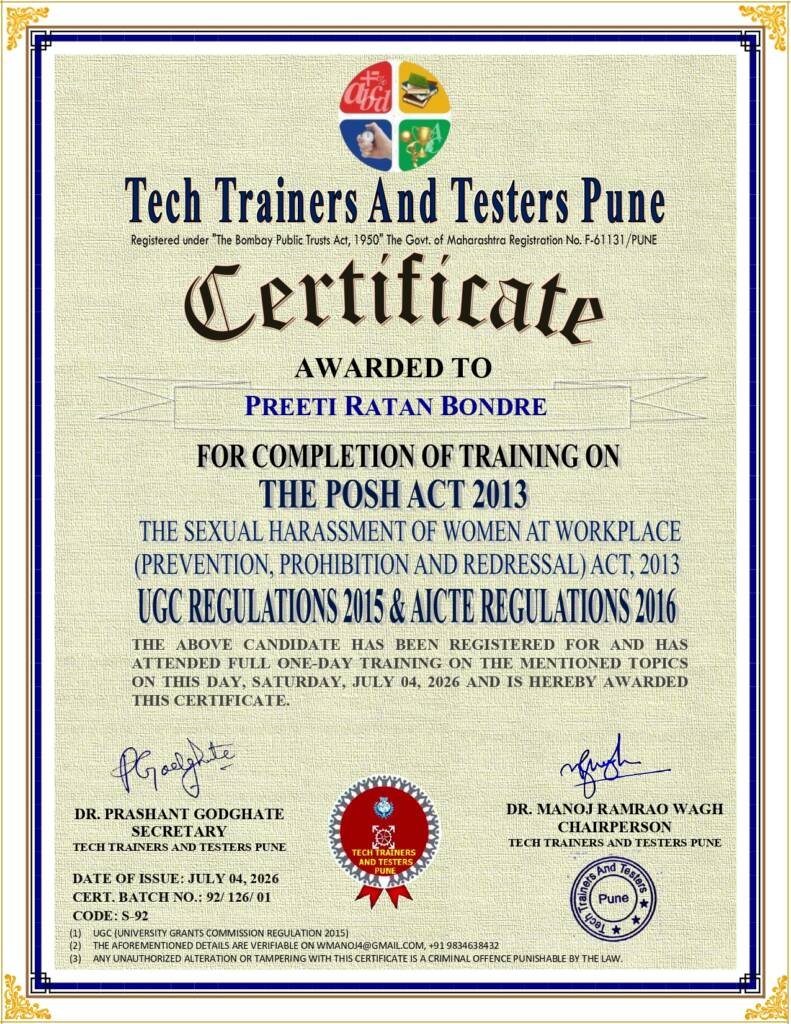
For nearly six hours, completely immersed in learning, and walked away not merely with a certificate, but with something far more valuable – a renewed appreciation of the depth, precision and responsibility that effective implementation of the POSH law demands.
Having attended numerous seminars, workshops and training programmes over the years, I can say with conviction that very few leave you with the humbling realization that while you may know the law, there is always another layer waiting to be explored.
The full-day intensive programme on the Sexual Harassment of Women at Workplace (Prevention, Prohibition and Redressal) Act, 2013, read with the UGC Regulations, 2015 and AICTE Regulations, 2016, conducted by Dr. Manoj Ramrao Wagh, was one such programme.
What made the programme exceptional was that it went far beyond discussing the provisions of the Act. It focused on implementing the law correctly.
The discussions covered the legal and practical nuances that every institution and organisation should understand, including:
Why the correct statutory term is Internal Committee (IC) and why nomenclature itself has legal significance.
The legally correct constitution of the Internal Committee, qualifications and disqualifications of members, and the rationale behind who should and should not be part of the Committee.
The powers and responsibilities of the Internal Committee, including the manner in which inquiries must be conducted in accordance with the Principles of Natural Justice.
The distinction between POSH inquiries and other institutional committees such as disciplinary, ethics committee, and student grievance committees.
Documentation that can withstand legal scrutiny, from complaints and notices to witness communications, proceedings and inquiry reports.
Institutional compliance requirements under the POSH Act, UGC Regulations and AICTE Regulations, including SHe-Box, SAKSHAM, awareness initiatives, mandatory display requirements and record management.
The programme also examined various judicial precedents that continue to shape the interpretation of workplace sexual harassment law. Among the landmark decisions discussed was the Supreme Court’s judgment in D.S. Grewal v. Vimmi Joshi & Others, which reiterated that in assessing workplace sexual harassment, it is not merely the intention of the respondent that matters, but the impact of the conduct on the aggrieved woman. The discussions also highlighted that even conduct not overtly sexual in nature may, depending on the facts and circumstances, amount to sexual harassment or contribute to a hostile work environment.
Most importantly, the programme reinforced a lesson that every educational institution and organisation must appreciate:
POSH compliance is not achieved by merely constituting an Internal Committee. Compliance begins when the Committee is legally constituted, adequately trained, procedurally sound, and capable of conducting fair, impartial and legally sustainable inquiries.
As someone who has always believed that legal education must extend beyond classrooms and statutes into practical implementation, this programme has further strengthened my resolve to contribute in this area.
I now look forward to translating these learnings into action. My immediate endeavour will be to train our teaching and non-teaching staff, identify and mentor our Gender Champions, and conduct sustained sensitization programmes within Siddhayog Law College. Through the Memoranda of Understanding (MoUs) entered into by Siddhayog Law College with neighbouring institutions, I also hope to extend these awareness and capacity-building initiatives beyond our campus, helping ensure safer and more respectful educational environments across the region.
Beyond that, I look forward to assisting educational institutions, organisations, and Internal Committees in building workplaces that are not only legally compliant, but also fair, safe, respectful, and firmly rooted in the principles of natural justice.
My sincere appreciation to Dr. Manoj Ramrao Wagh for an intellectually stimulating programme that reminded me why, irrespective of the roles we occupy, lawyers remain lifelong students of the law.
The learning truly never ends.